
8 Must-See Documentary Shorts from Hot Docs 2026


After taking a bit of a break over the past few months to reset, we are thrilled to be back for the 2026 festival season. We have an exciting slate of festival coverage planned for this Spring/Summer and there is no better way to start it off than talking about our favourite documentary shorts seen at Hot Docs. Brandon and Pedro are joined by guest writer Jeff Bulmer to shoutout some of the best shorts we saw throughout the week.
A Quiet Storm, dir. Benjamin Nicolas

In A Quiet Storm, Benjamin Nicolas documents the reality of Maïto, a 14-year-old prodigy in Krump dance. He is a sensation, one of the best dancers in Japan, still, the film focuses on his mother, who sacrificed a lot in her life to raise him and his sister, who has disabilities. Hence, the film is an empathetic observational look at the routine of this young dancer and the woman behind him, the one who provides the foundation that allows him to thrive as one of the best dancers in the country. Throughout the relationship between the dancer and his sister, A Quiet Storm presents the mother as a thoughtful, hard-working individual who educates her disabled daughter through sign language and creative activities. Meanwhile, she motivates her son to be the best. Despite the conventional framing of the film, Nicolas manages to find a few breathtaking shots of Maïto dancing in the rain, while the camera captures him in slow motion. Thus, A Quiet Storm presents us with the occasional beauty of dance on the big screen and the compelling story of a loving mother and her children.
-Pedro Lima
A Wolf in the Suburbs, dir. Amélie Hardy

With an eccentric (complimentary) character at the forefront and a dash of civil disobedience to boot, A Wolf in the Suburbs follows Wolf Ruck in his battle with the city to keep things wild on his property. All Canadians know the type; the people who spend all spring and summer meticulously weeding, watering and cutting their lawn, only for it to be covered in leaves and snow for six months out of the year. I often think of it as the "Oakville" type, so it’s no surprise that these are the types of people Wolf is taking on in neighbouring Mississauga, Ontario. Wolf poses the idea of what would happen if as homeowners we just didn’t maintain our lawns and let nature grow wild and harbour homes for the insects and birds. “Rewilding” is the official, coined term for the movement.
A Wolf in the Suburbs is riveting. I sat invested as Wolf Ruck - a former Olympian who takes his cat for walks on a leash in his yard - takes on Facebook Karens, town by-laws and the court system. He is, at all times, calm, measured and prepared, even when the town shows up to take the mower and whipper-snipper to his yard — as you find out, you don’t mess with a Wolf! I end this with a quote that has stuck with me since I saw this short.
"A little chaos never hurt anyone, in fact, it's in the tangled mess that life actually happens."
- Brandon MacMurray
BAEA, dir. Terra Long

It's almost as though this documentary was made especially for me; it focuses on two unique personal interests of mine. As you may or may not know from my previous reviews, I am an avid birder. I also spend most my days or nights (depending on the shift) at my full-time job in a hospital, specifically testing patients' blood. BAEA follows the rescue of bald eagles at a Canadian wildlife centre who are suffering from lead poisoning. It is a stunning look at the fragile relationship between humans and nature as it explores the unintended consequences of hunting in these areas. BAEA subtly yet effectively debates what the most compassionate approach is, tackling cases of both heartbreak and success. The contrast between the vastness of the cinematography in the landscape shots and the close-up shots during treatment are effective in showing how majestic these birds are and what freedom and health truly means to them.
-Brandon MacMurray
The Baker's Hotline, dirs. Emily Schuman, David Schuman

The Baker’s Hotline profiles the King Arthur Flour Baker’s Hotline, a number people can call to get on-demand advice from expert bakers. Through anecdotes and interviews with the experts manning the phones, and the amateurs calling in, this documentary shows human connection budding in unexpected places.
While the doc is lighthearted, a theme of loneliness connects the characters. One of the operators, Clara, laments the isolating nature of working in a bakery. Waking up at 2 AM to be the only person in the building for several hours before leaving at the start of everyone else’s shift. On the other side, each of the callers relates their own struggles with loneliness. Mark Melius, a doctor of chemistry, remembers his late mother through baking bread. Lottie, another caller, talks about taking up baking during the COVID-19 pandemic. More than one unnamed caller talks about not being able to share their baking with others, simply due to not knowing many other people.
In one of her only interjections, co-director Emily Schuman asks an operator “do you think most people are just craving connection?” who immediately responds “Oh yeah, everyone is.”
-Jeff Bulmer
My Body Goes to Work, dir. Fernanda Molina Perez Diez

Labor is a central element of one's life. In a sense, it is a vital necessity of the human being to perform activities to survive, monetarily and in the soul. Yet the meaning and symbolism of work are recent concepts. The newer generations brought the notion of love to the labor field, assigning meaning and necessity to doing it to fulfill one's expectations. Similarly, in Fernanda Molina Perez Diez's My Body Goes to Work, we learn about Nevaeh. She is a woman who lives in Toronto and has two jobs - a birth worker during the day and a dancer in a strip club at night. Therefore, she performs two activities opposed to the admiration of one's work. Giving birth is beautiful, a life assistance; yet, sex work is immoral in some societal circles. Still, Molina Perez Diez strives to expand the connection between Nevaeh's necessity to perform jobs that require her body strength. Both dancing in a club and assisting in a birth require the most from her muscles, but there is a passion in the double shift. Thus, My Body Goes to Work is another sympathetic portrayal of sex work, while showcasing the meaning of it, drifting away from all of the existing stigma surrounding it.
-Pedro Lima
Oh Whale!, dir. Winslow Crane-Murdoch
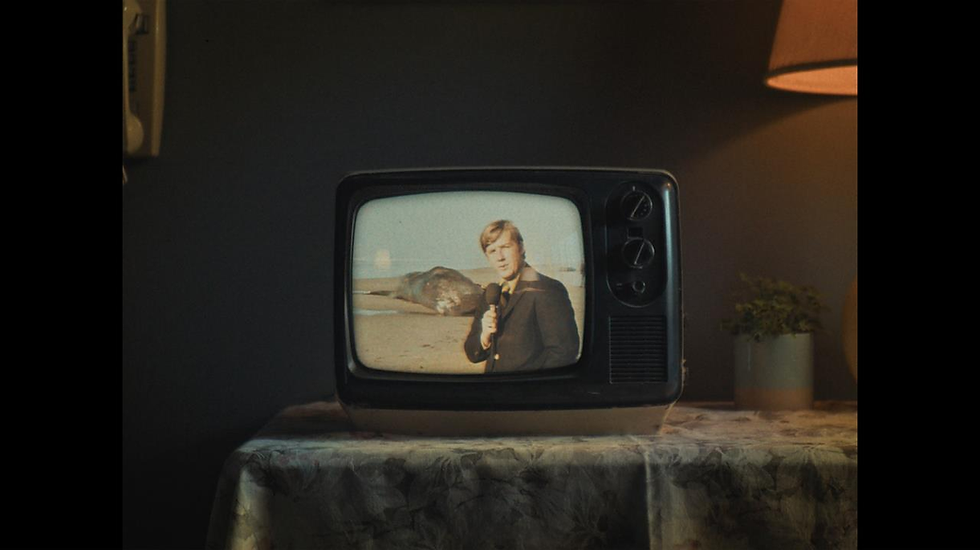
Oh Whale! tells the story of Paul Linnman and Doug Brazil, two Oregon journalists most famous for reporting on the Florence Whale Explosion in 1970. That year, the Oregon Department of Transport decided to use legendary amounts of dynamite to remove a washed-up whale carcass. The broadcast, a ratings giant at the time and now immortalized as a meme, is a great story about what not to do when disposing of oceanborn detritus. As Doug Brazil reminisces: “The moral of the story is never underestimate the power of explosives.”
On the surface, Oh Whale! is a fun behind-the-scenes look at the creation and legacy of that story. Lengthy segments focus on the impact of the Whale Explosion on Florence itself, now a tourist destination thanks to Linnman.
There’s a more tragic element to the documentary, though. Director Winslow Crane-Murdoch starts with a profile of Linnman and Brazil’s careers as newsmen in the 60s. The two were quite accomplished, covering everything from breaking news to political campaigns and human interest pieces. There’s plenty that Linnman could be known for throughout his career as a serious journalist. Now in the later years of his life, the thing he’s most closely associated with is maybe his silliest story.
At the core of Oh Whale! is a story about the inscrutability of legacy. Linnman and Brazil are accomplished, but neither could ever have predicted what that would end up being. The Exploding Whale has become so meaningful to an entire community beyond Linnman and Brazil, but one has to wonder if it’s bittersweet that a step off the beaten path would become these men’s claim to fame.
-Jeff Bulmer
Replikka, dirs. Piratá Waurá & Heloisa Passos

Brazil has a history of forgetting. In the country where, forty years later, people are still waiting to receive updates about the remains of relatives kidnapped, tortured, and killed by the dictatorship, memory is scarce. Historically, it reserved itself for white individuals and colonials, placing them in our classrooms and museum patios. Yet, in Replikka, the new documentary short by Heloisa Passos, a well-recognized Brazilian non-fiction filmmaker, she co-directs with Piratá Waurá, a photographer from the Waurá tribe, to tell their history. The film portrays the importance of the Gruta de Kamukuwaká, a sacred cave for that community, and it became a material belonging to humanity. Unfortunately, due to vandalism, a 3D replica had to be created for studies and preservation. Hence, Passos and Piratá contribute to a new portrayal of the indigenous in the audiovisual format, as storytellers, and inviting their own community to participate in the telling of their stories. Similar to the films by Vincent Carelli and Taego Ãwa by Marcela and Henrique Borela, Replikka is a testament to the necessity public attention to those tribes and demanding their rights. After all, they are the protectors of the original Brazil; we will not be able to replicate them in the future, unlike the sacred cave.
-Pedro Lima
Some Kind of Refuge, dir. Alexandra Kern

At the margin of the Mississippi River, there is a place named The Batture. In the past decades, that line near the water had plenty of houses that welcomed people needing either spiritual or economic solutions. Alexandra Kern captures a community fading away due to the late stage of capitalism, the need to construct buildings. Hence, the director documents the imagery of a place that is slowly erasing itself from the past decades, leaning towards the hegemonic concentration of capital, and the brutal disowning of individuals who bravely fight to stay there. Similar to Kern's brilliant Stud Country, which narrates the last gay line dancing bars in Los Angeles, Some Kind of Refuge is about the inevitable displacement of culture in favor of profit. The director establishes herself as someone interested in immortalizing the communities targeted by the system. In 21st-century America, the capital speaks louder than ever. Hence, it leaves us with a melancholy portrayal of the sundown reflecting on the river's water, while the guitar playing in the score cements us to a sonic somber state, acknowledging the destiny. Soon enough, those people will become fading memories, while the new company on the river is the billion-dollar evaluation of a real estate business.
-Pedro Lima


Comments