
2026 Hollyshorts Film Festival Review Roundup: Part 2

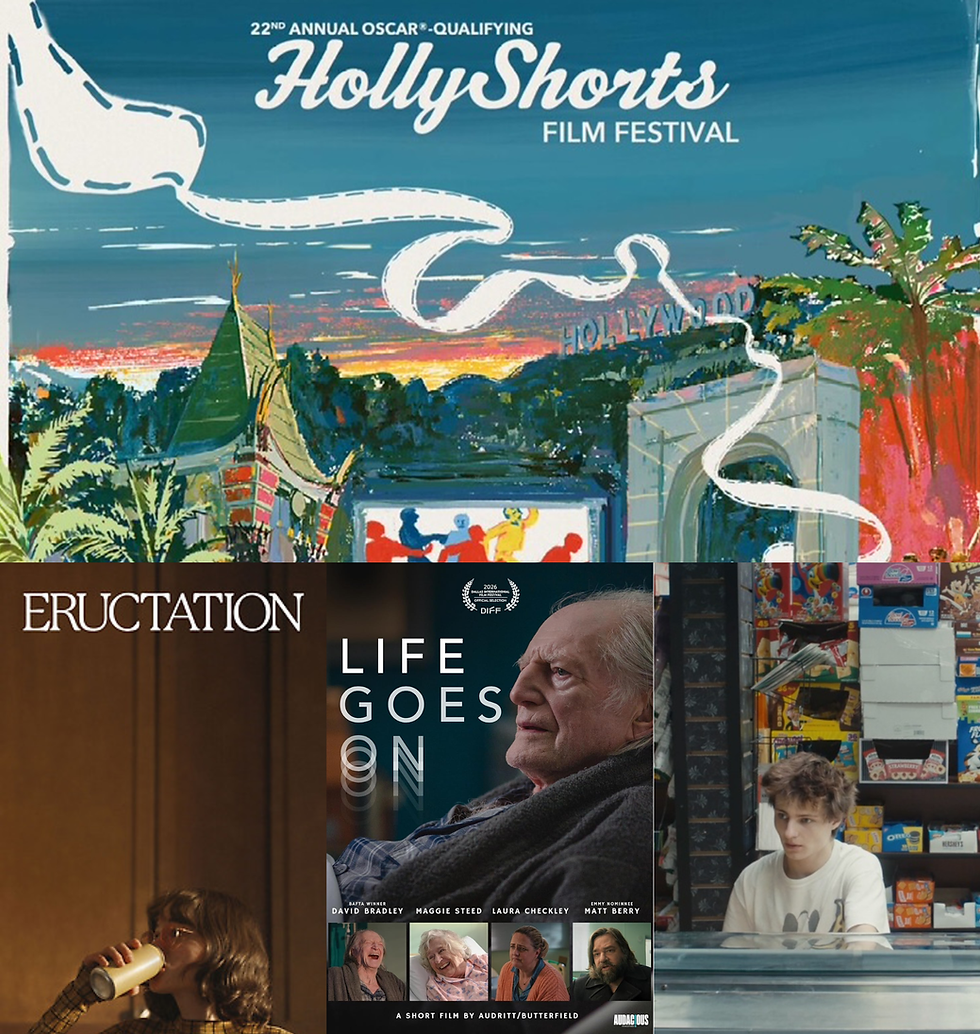
Our coverage of Hollyshorts continues with three more reviews, as Robin talks about Life Goes On, Pedro reviews Chop Cheese and guest reviewer Jeff writes on Eructation.
Eructation, dir. Victoria Trow

“You gotta take what talent you’re given and try to foster it. Make it as good as you can.” For Kaylee, that talent is burping.
Victoria Trow’s short documentary Eructation profiles a woman preparing to break the world record for loudest female burp. The film takes the form of an extended quirky interview. What drives a woman to burp? What does incorporating this into your life mean? Kaylee is forthcoming and matter-of-fact. In pursuit of her goal, she keeps “burp diaries,” with her observations on what foods and behaviours lead to louder burps. Kaylee lives the life of an athlete, honing her stomach through beer, cereal, and soup in preparation for world record attempt day, when she’ll go down in history with the loudest female burp ever recorded.
Kaylee’s stated reason for pursuing the world record is that she measured one of her burps once as 110 dB. Since the world record for loudest female burp is 107 dB, she immediately became obsessed with repeating the feat.

Kaylee rarely veers from talking about burping, but her few diversions are revealing. “It’s been kind of hard on the marriage,” she mentions in passing near the end. Her husband, Eric, looks consistently annoyed. In his interviews, he makes an attempt to be supportive, but it’s clear he simply does not share the same passion for burps as his wife. He openly talks about her most annoying tendencies after deciding to become a world champion burper. To paraphrase Kaylee, he’s super excited for it all to be over.
Trow’s film fits in with similar light documentaries focusing on a fun curiosity, but through her directorial choices, Trow is able to get something deeper out of Kaylee and Eric. For nearly every interview segment, Trow will have either Kaylee or Eric do something loud in the background – vacuuming, mowing the lawn, drying hair – with an onscreen indication of the decibels of that activity. It’s rarely intrusive enough to drown out Kaylee or Eric’s words entirely, but it always makes it frustratingly difficult to focus on what’s being said.
At every point, the documentary itself is disturbed by unwelcome sounds. Not unlike Kaylee and Eric’s relationship, thrown into disarray through Kaylee’s strange obsession with burping loudly.
Review by: Jeff Bulmer
Life Goes On, dirs. Daniel Audritt, Kat Butterfield

The creative duo of Daniel Audritt and Kat Butterfield are perhaps best known, individually and in tandem, for their work in TV, but here they band together to create a star studded live action short film. Led by David Bradley playing the dying elderly gentleman Bill, who is spending his final days in a hospice bed. Surrounded by nurses (Jayne Aguire, Brona C. Titley), family (Laura Checkley, Matt Berry, Amanda Root) and other patients (Maggie Steed), we see him struggle to find rest in a remarkably busy environment.
The story here is structured around a cruel time-loop, starting with the morning of Bill’s last day and ending as his heart stops later that night. Sprinkle in some proper British dark comedy, a handful of absurd situations and a healthy dose of cussing and you got yourself a good time. A few laps around the loop to get Bill up to speed with what’s happening, a couple more to have him start to push the boundaries and make bold decisions, and countless more to have him longing for the sweet relief of moving on.
Now that’s all well and good, don’t get me wrong, I chuckled every time the ridiculously cheerful hospital musician storms into the room with his natural talent to find the absolute worst timing to bring joy to others. But there is more to this story, owing much to the clever setting which brings a familiarity for anyone who has suffered the long goodbye of a loved one.

Take for example the family members who visit out of some form of obligation, or as Bill puts it “they’re all here for themselves”. His words of course stem from his grumpy outlook on life in general, but there is a very real strain associated with death and the human nature of struggling to cope with it. Another good example of this is the staff going above and beyond to make things as comfortable as they can, oftentimes with little to no appreciation for it. It is a very intimate setting and not always by choice, but their nurturing nature still means they show up day out and day in with a smile on their face ready to assist.
Goodbyes are hard for everyone no matter the setting. Everything comes to a point when there is no longer the option to do the same old and put off plans or conversions for another day. You often hear about people's regrets in their final days, but the same topics are rarely challenged when there is time to still adjust and appreciate.
Remember to tell your parents, or better yet your kids, that you love them. Not in that silly, off handed, throwaway manner you usually do, speak the actual words, they matter.
Review by: Robin Hellgren
Chop Cheese, dir. Sophia Meloni

In New York City, the bodegas became a social center. People gather there and interact, either as friends eating and drinking or as customers conversing with the workers. In Chop Cheese, Sophia Meloni narrates a comical story. A group of friends attend the same bodega every day. One of them orders the signature sandwich, and the cook answers with a "sure, boss". However, the other kid (Dylan Martin Frankel) gets a yes, kid. Hence, he becomes obsessed with the idea of getting that preferential “Sure, boss” treatment from the bodega worker as he attempts to acquire it by ordering the chop cheese every day. Eventually, this newly-found chop cheese addiction leads him to needing to get a job to pay for it.
The debut director, Sophia Meloni, creates a circular story about NYC's relationship with spaces like the bodegas and the respect earned from the workers there. In this sense, the venue becomes a place where individuals gather to talk about life, drink before a party, or eat after an event. It became a part of the New Yorker culture, especially because it carries the identity of the immigrants who own the places and provide them as a slice of their cultures. Meloni captures it as a center for the youth to drink sodas, talk about girls, and converse with adults on a level of parity. For that kid, the most important thing in his life as of now is getting recognition from the bodega's cook. He is the man who will welcome him into adulthood and acknowledge him as a man.

In this sense, it sounds silly when we analyze the man's effort to feel connected to the others. Yet, Meloni documents that he is willing to lift weights and work delivering drinks to all of the city's bodegas to earn respect from one man. It is also funny how his delivery man gig sounds like a Coke product placement, especially the way Meloni films Frankel among the extensive trucks that deliver tons of soft drinks around town. The cadence and tone are important to set it as a slice of life of the city that is constantly moving, including 16-year-olds who get a job to pay for a chop cheese. The whole narrative is inherently fun, and there is some substance in its threads; people, especially boys in their formative years, need the attention and recognition of others.
Framed in its kineticism and the fun cyclical story, Chop Cheese has a say in how people want to be seen by others. It is an interesting first short for Sophia Meloni, who even features her father, Christopher, and Michael Gandolfini as the other bodega workers in a hilarious conversation about weed and work. In the end, Chop Cheese is a good time in the mind of a young man, eager to get attention and respect from another man, even if it is simply a slang term: boss. Everyone can relate to wanting affirmation in life. Sometimes we just need one word said to us, even if it changes who we truly are to get there.
Review by: Pedro Lima


Comments