
2026 Ottawa International Animation Festival Review Roundup: Part 2


Ottawa International Animation Festival always brings it with a spectacular lineup of diverse stoies and animation styles. In part 2 of our coverage of Ottawa International Festival, Joshua reviews 3 more favourites from the fest! See what he thought of When the Sea was Calm, The Other Ones and The Stars Watch From Long Ago.
When the Sea Was Calm, dir. Mamuka Tkeshelashvili

The sea is calm at the beginning of Mamuka Tkeshelashvili’s When the Sea Was Calm. The film opens on a summer in Sokhumi that seems suspended outside of history: a young boy rides his bicycle, plays football with his friends, swims in the Black Sea and meets a girl visiting the city. There is laughter, sunlight, barking dogs and the restless energy of a teenager discovering that the world might suddenly be much larger than he thought. It is an ordinary childhood, which is precisely what makes what follows so painful.
Set in 1992, on the eve of the War in Abkhazia, When the Sea Was Calm turns a personal memory into a portrait of a place that was about to disappear from the life of its protagonist. Tkeshelashvili has described the film as being rooted in memories of Sokhumi and a real love story, and that autobiographical quality gives the film an unusual intimacy. This isn’t history viewed from a distance. It is history experienced as the sudden interruption of a summer.
The film’s handmade construction is central to that idea. Tkeshelashvili combines puppets, cut-outs, miniature architecture and hand-crafted sets, giving Sokhumi the appearance of a remembered place rather than a reconstructed one. The buildings and characters have a delicate physicality, they look as though they could be picked up and held, a fragility that becomes increasingly significant as the film progresses.
At first, the slightly artificial movement of the stop-motion contributes to the film’s dreamlike summer atmosphere. The boy’s world is small and tactile: a bicycle, a football, the beach, the girl and her dog. But when the war arrives, Tkeshelashvili radically changes the visual language. The camera becomes unstable, with first-person perspectives, sudden zooms, fisheye distortion and rapid movement creating something remarkably close to handheld live-action. The technique is deliberately disorienting, as the characters no longer seem to inhabit a carefully constructed miniature world but seem trapped inside one that is collapsing around them.

The transition is especially effective because the film doesn’t begin by explaining the war. Instead, the intrusion of violence is almost absurdly simple. A plane appears, the atmosphere changes, missiles and explosions follow. The girl’s family is forced to leave, and in the confusion she loses her dog. The boy finds the animal and carries it with him as he escapes the burning city. It is a small gesture, but Tkeshelashvili understands that displacement is ultimately made up of small things: the person you cannot find, the animal you refuse to leave behind, the object you carry because it connects you to the life you had yesterday.
The historical reality behind these scenes makes them more devastating. The war began in August 1992 as fighting erupted between Georgian government forces and Abkhaz forces seeking greater autonomy and ultimately separation from Georgia. Sukhumi became the center of the conflict, suffering repeated attacks before Abkhaz forces captured the city on September 27, 1993. The fighting resulted in mass displacement, with more than 200,000 people forced from their homes in Abkhazia, the majority ethnic Georgians.
Yet When the Sea Was Calm is careful not to turn those facts into a conventional war film. Its interest lies less in military history than in the way political catastrophe enters private memory. Decades later, the boy returns to the ruined city as a grown man, which feels less like a homecoming than an encounter between two versions of the same person. Archival footage enters the animation, breaking the handmade illusion and reminding us that the miniature city we have been watching was never merely imaginary. The past was real, the ruins were real, the summer really ended and that is what makes the title so powerful: the sea itself remains. The Black Sea that framed the boy’s childhood has not disappeared, even though almost everything around it has changed, and the calm becomes something impossible to recover but impossible to forget.
Tkeshelashvili’s great achievement is to make that contradiction visible, that a beautiful summer can survive in memory even when the world that contained it does not. When the Sea Was Calm is therefore not simply a film about the War in Abkhazia. It is a film about what history looks like when reduced to the scale of one childhood. Its politics are inseparable from its tenderness, and its handmade animation gives that tenderness a physical form. Every little figure, building and piece of scenery seems capable of being broken. The film understands that sometimes the most devastating way to depict the destruction of a place is to first show us how much it was loved.
Review by Joshua Hunt
The Other Ones, dir. Jamesie Fournier & Danny Christopher

T
here is something inherently unsettling about being told not to do something as a child without ever being given a reason why. Jamesie Fournier and Danny Christopher’s The Other Ones takes that familiar childhood warning and turns it into an eerie piece of Inuit folk horror, where a simple game passed between generations becomes a doorway to something waiting beneath the ice.
The film follows a mother and daughter who travel to a remote cabin to repair a fishing net. While there, the daughter begins playing with the leftover string, making the string figures her grandmother taught her. It is an innocent game, but her mother warns her not to do it at night, that there are things you might wake up. Naturally, the warning goes unheeded, and the Other Ones begin to emerge, goopy ghouls with too many appendages and not enough teeth. The stop-motion animation gives the film a wonderfully tactile quality. Its fully articulated puppets wear hand-sewn clothing, while the miniature cabin was modeled after the home of Fournier’s cousin near Iqaluit. The effect is less like watching an artificial animated environment and more like looking into a carefully constructed memory. Every piece of the cabin—the furniture, clothing, fishing equipment and small domestic details—helps establish a lived-in world before the supernatural begins to intrude.
That physicality also makes the horror more effective. The cabin is small, warm and familiar, but it is surrounded by an enormous frozen landscape. There is nowhere to escape to, and beneath that frozen landscape is something the characters cannot see. The filmmakers use the limitations of their miniature world to create a sense of claustrophobia. The closer the camera gets to the puppets, the more the handmade quality of the animation becomes uncanny. These aren’t photorealistic creatures pretending to exist in our world, they belong to a world constructed by hand, and the supernatural feels as though it has been constructed into it from the beginning.

There is an especially interesting connection between the film’s story and its method of creation. String figures are created through a series of precise movements, transforming an ordinary piece of string into recognizable shapes. Stop-motion animation works in a similar way: an inanimate puppet is moved a tiny amount at a time until, through the accumulation of individual frames, it appears to come alive. The Other Ones uses one form of physical transformation to tell a story about another.
The use of Inuit folklore is what gives The Other Ones its greatest distinction. String figures are part of Inuit cultural tradition, passed between generations, and the film builds its supernatural premise around the warnings associated with making them at night. This makes the daughter’s actions more significant than the usual horror-movie decision to ignore an ominous warning. The danger comes from a tradition she has inherited without fully understanding, and that idea of inheritance runs through the entire film. The mother is not simply protecting her daughter from a monster, she is trying to pass down knowledge that was given to her by her own mother. What initially seems like an old superstition becomes essential when the supernatural rules of the story prove to be real. The horror comes not just from the Other Ones themselves, but from the possibility of losing the knowledge that tells us how to live alongside them.
The film’s use of Inuktitut and its Inuit performers reinforces this sense of cultural continuity, while the score by Inuit throat-singing duo PIQSIQ gives the film an atmosphere that feels inseparable from its setting. The sound and imagery work together to create a world in which the supernatural does not feel like an outside force imposed upon Inuit culture. It grows naturally from the culture itself. The Other Ones are frightening partly because they remain mysterious, and the film leaves us wanting to know more about them and the rules governing their existence. That ambiguity also gives the story the quality of a traditional tale: not every mystery needs to be explained, and not every warning comes with a footnote.
Fournier and Christopher turn that idea into something larger than a conventional monster story. The Other Ones is about memory, family and the fragile process of passing knowledge from one generation to another. Its creatures may come from beneath the ice, but the real subject is what happens when the stories and warnings of the past are no longer taken seriously. The film’s final achievement is making those stories feel alive—not as artifacts of a distant culture, but as something contemporary, personal and capable of frightening us right now. The old stories aren’t dead, they’re still being told, still being learned, and, perhaps, still waiting beneath the ice.
Review by: Joshua Hunt
The Stars Watch from Long Ago, dir. Stacey Steers
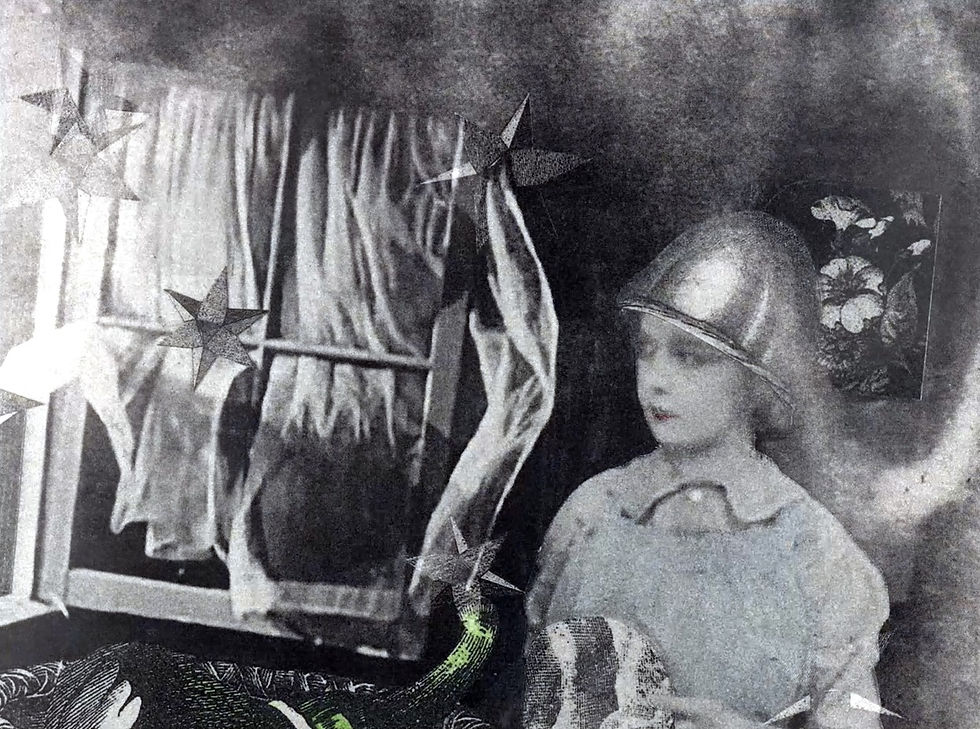
A farmhouse drifts through outer space, tumbling slowly among stars and darkness, carrying a woman with it as if someone has simply picked up a piece of the American landscape and thrown it into the heavens. The image is both absurd and strangely melancholy. In Stacey Steers’ The Stars Watch from Long Ago, the familiar becomes cosmic, and cinema itself becomes the raw material for a dream about memory, loss and the stubborn persistence of life.
Steers spent seven years constructing the film from thousands of pieces of handmade paper collage and that labor is visible everywhere. Flowers, insects, stars, buildings and human figures have the slightly unstable quality of things that have been cut out and painstakingly put back together. The images never quite settle into the seamless illusion of conventional animation, their edges remain present, and paper becomes landscape, an old photograph becomes a face, an engraved flower becomes an alien organism. The effect is less like watching a new world being invented than discovering one inside the pages of an enormous, very strange scrapbook.
The human figures are themselves fragments: Steers takes performances from early cinema, most notably those of Lillian Gish and Janet Gaynor, and removes them from the films in which they originally appeared. Gish, whose expressive face once had to communicate entire emotional states without dialogue, becomes particularly fascinating when stripped of her original context. A glance that once belonged to a melodrama now belongs to a woman floating through the cosmos and a gesture designed for one story acquires another meaning simply because Steers has moved it somewhere else.
That transformation gives the film much of its emotional force. Home is supposed to be the place that keeps us anchored, yet here it is the thing carrying its inhabitants away. The characters seem suspended between worlds, surrounded by objects that have lost their ordinary scale and function. Flowers become enormous, insects acquire an almost mythological presence and the landscape continually threatens to dissolve into abstraction.

The threat of environmental destruction gradually emerges from this dreamlike imagery. The beautiful paper landscape can burn, the tiny creatures inhabiting it can disappear, and the fragility of the handmade images becomes inseparable from the fragility of the world they depict. The faces of Gish and Gaynor are already ghosts before the film begins, they belong to another century, preserved on film long after the people who performed those gestures have disappeared. Cinema becomes an archive, but also a material that can be cut apart and rearranged, or a performance can survive while its original meaning disappears. Steers is not merely quoting old films; she is testing how much emotional life remains inside their images once their original narratives have been removed.
The title, taken from W. S. Merwin’s poem “Rain Light,” gives this movement through time its final dimension. The stars are distant, but the light reaching us comes from the past. The metaphor fits Steers’ method almost perfectly. Every image in the film is a piece of light from somewhere else: a silent-film actress, an old illustration, a flower pressed into a book, all have travelled through time to arrive here. John Romano’s editing completes the illusion. The collages do not behave like static illustrations simply brought to life, but overlap, recur and transform, allowing the film to move according to the logic of memory rather than conventional narrative. Faces become landscapes, landscapes become memories, memories become dreams.
The result is a film that feels less concerned with travelling through space than travelling through cinema itself, from childhood to old age and from the handmade world of paper to the terrifying vastness of the stars. Steers has built a film from things that have already been displaced: old performances, discarded images, extinct moments, fragments of other stories. She gives them a new world to inhabit, even as that world seems to be disappearing around them. The past watches from a great distance, but it has not stopped looking.
Review by: Joshua Hunt


Comments